top of page

Research Blog

Search
Writer: Trevor Alexander Nestor
Trevor Alexander Nestor
May 19
9 min read

Updated: May 29

A presentation on lattice-based cryptography, the shortest vector problem, and its surprising

connections to consciousness, biophotons, and the black hole information paradox.


Video presentation: https://youtu.be/jSqeYz8Wh-Q


Introduction

Today I would like to present on the topic of possible vulnerabilities of post-quantum

cryptography to emerging physics beyond the standard model. This is a controversial topic I've

thought deeply about for the last 15 years, going back to when I was a student of Fields Medalist

Dr. Richard Borcherds at the University of California, Berkeley, who specializes in lattice

mathematics and string theory and is famous for solving what is called the monstrous

moonshine conjecture. It isn't clear to me why this presentation is banned from both Reddit and LessWrong, it's pretty trivial to both check citations and also show it's not AI generated (the video presentation where most of this is extracted transcript directly from this article is in my natural cadence, and I was working on these opinions even before LLMs became mainstream though admittedly sometimes I use it for formatting - maybe more evidence that academia, science, and technology have become more of an orthodoxy like a religion - like a pyramid scheme of interlocking monetary incentives that seeks to repress outside thought?).


The Baseline Assumption, and the Surprise

We start with the base assumption that in the next few years quantum computing is likely to

imperil our current cryptographic standards. This is what prompted the National Institute of

Standards and Technology in 2018, when I was visiting Boulder, Colorado, to evaluate newer

standards that are supposedly resilient to both quantum and classical attacks:


The resilience of post-quantum cryptography to both quantum and classical computers has

never been fully proven. In fact, one of the candidates for post-quantum cryptography, known as

SIKE, or supersingular isogeny key encapsulation, surprised the entire cryptographic

community when it was cracked within only 62 minutes on a standard Intel CPU.


Post-quantum cryptography is based largely on what are called lattice problems and the

difficulty of resolving what is called the shortest vector problem over a high-dimensional lattice,

or its close geometric equivalent, the non-commutative torus. SIKE was isogeny-based, not lattice-based. Its break (an algebraic attack using Kani's theorem on abelian surfaces) has no implication for the security of ML-KEM/Kyber or other lattice schemes, but we can think of it as a motivation to consider that reality itself may prove to be less predictable than mathematicians or cryptographers have assumed.


My own personal view has always been that any truly unbreakable encryption is too hubristic a

request of the universe, and there is a pattern of nature surprising us and collapsing even our

strongest assumptions. So while this problem seems impossible from the perspective of classical

attacks from any classical physics, and from the perspective of quantum attacks from quantum

physics, there is one emerging area of physics, at the intersection of classical and quantum

approaches, or physics beyond the standard model, that has evaded much attention.


Three Problems, One Shape

The NP-hard shortest vector problem, where NP-hard is a classification of computational

complexity, is related to the so-called learning with errors problem. That problem is needed to

understand how the brain efficiently achieves the equivalent of backpropagation, and also what

is known as the perceptual binding problem, which is the problem of how the brain binds

sensory features into coherent experiences. Cryptography uses approximate-SVP, which isn't known to be NP-hard in the relevant approximation regimes; in fact, gap-SVP at the parameters used is in NP ∩ coNP and unlikely to be NP-hard, but lattice crypto's hardness assumption is weaker than people sometimes imply when they wave around "NP-hard." Only exact SVP and SVP with small approximation factors are NP-hard, which is a stronger problem we are going to think about where lattice problems are thought to be intractable under worst case assumptions.


The perceptual binding problem was mapped to the shortest vector problem by researchers like

Tsotsos, and brain neural networks have been mapped to high-dimensional lattices and non-

commutative tori in academic literature by groups like the Blue Brain Project. More recently

some have (unconvincingly) contested Tsotsos' work, proposing that the way in which the brain

achieves perceptual binding is by so-called "predictive coding." Strictly hierarchical or merely approximate models of perceptual binding, however, (like predictive coding) assume that the

brain successively pools local features into ever more complex conjunctions until a unified

object code emerges. Empirical evidence now shows this feed-forward scheme is insufficient:

MEG and fMRI reveal that the moment at which features are bound coincides with the onset of

late, recurrent activity that re-enters early visual areas, and when these feedback loops are

disrupted pharmacologically or with Transcranial Magnetic Stimulation (TMS), illusory

contours, perceptual switching and contextual grouping all collapse even though the putative

"higher"; hierarchical stages remain intact.


Tsotsos mapped visual attention complexity to an NP-hard problem in a computational-complexity sense which is exactly what we are referring to here.


The shortest vector problem has also been tied to the black hole information paradox in

academic literature, because on the surface, the black hole information paradox is a kind of

cryptographic question involving the flow of information one way across an event horizon, but

somehow this information must escape in some scrambled fashion from the black hole to

preserve information unitarity, which quantum theory demands.


So there is a kind of near equivalence between these problems. Post-quantum cryptography, the

black hole information paradox, and the way in which the brain processes sensory information

and binds it into a coherent experience. At least as a starting point, in theory it might be possible

to use cultures of biological neurons stimulated to encode a lattice problem to somehow retrieve

the shortest vector over that lattice, and understanding the physics of this may shed some light

into the black hole information paradox, at least from what we know so far.


As a brief aside, this might even shed some light on the physics of collective behaviors of people

in social networks, since we know that brain activity synchronizes across individuals in a group,

that collective intelligence seems to scale faster in groups than adding individual intelligence

together, and that more controversial theories like so-called social laser theory, which I admit

sounds somewhat strange, attempt to explain the sudden emergence of macroscopic quantum-

like collective behaviors in groups of people. In cybernetics theory, social networks of people are

much like brain neural networks, where one-way flows of information in the form of transactions between social and economic institutions often backpropagate in the form of

unpredictable behaviors.


The Proposed Experiment

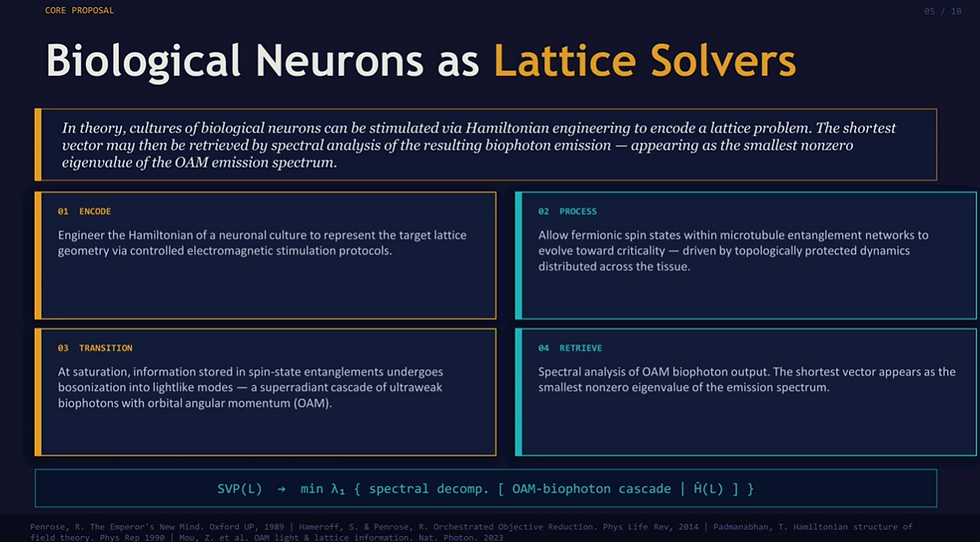
So let's say we have a culture of biological neurons and we train these neurons to represent a

lattice problem, which we can theoretically do by Hamiltonian engineering. How can we retrieve

the shortest vector over that space?


There is a good amount of evidence mounting that underneath the neural network layer in these

tissues, within neuronal cytoskeletons, there are long cylindrical proteins called microtubules,

which host topologically protected fermionic spin states. The reason the brain is so efficient at

compute, operating on only about 20 watts of electricity when compared to the supercomputers

we have (the ones many tech leaders would like to power with their own dedicated nuclear

power plants) is because this physics is much more efficient than what is facilitated by

electrochemical signaling alone.


Within these microtubules are supposed to be entangled networks of these fermionic spin states

distributed across the tissue. The idea is that they are driven or orchestrated to a point of

saturation, and then at a critical phase transition, the information stored within the

entanglements of these spin states gets bosonized into light-like modes.

In experiments what this looks like are superradiant cascades of ultra-weak Majorana-like

vortex biophotons, or biophotons with a quantum property called orbital angular momentum,

and other possible forms of structured light (such as Skyrmions or Hopfions) which carries the

information that was stored in these spin states. At critical points, the superradiant cascades

broadcast error backpropagation across the brain tissue, and account for perceptual binding.

Experiments have demonstrated these superradiant cascades and even that light can modulate

long-term potentiation and long-term depression in neuron cells.


In theory, then, it should be possible to extract the shortest vector over our lattice space by

spectral analysis of this light, where the shortest vector should appear as the smallest non-zero

eigenvalue. Recent work has also shown that OAM light is capable of storing information about

the high-dimensional lattice geometries that would be needed.


What Evidence Do We Have?

So what evidence do we have of this supposedly niche, fringe theory? It turns out there has been

quite a lot of evidence accumulating over the years.


First, experiments done with xenon anesthetics blocking microtubule channels showed that the

isotope of xenon used modulated anesthetic potency, suggesting that the quantum property of

spin might be implicated in the way the brain processes information through what is called the

radical pair mechanism.


We also know that the speed and efficiency of the brain cannot fully be accounted for by

electrochemical signaling, and that information is non-locally distributed across the tissue,

which is stored and retrieved much differently than what you would see in a von Neumann

architecture.


Studies of microtubules show resonance frequency peaks across scales consistent with

conformal field theories, and even time-crystalline behaviors, which could be implicated in the

way microtubules facilitate backpropagation. The idea here is that fermionic, possibly Majorana-

like spin states might be hosted within the hydrophobic pockets of microtubules, and the

information might be bosonized into these superradiant cascades, where the microtubules act as

optical waveguides.


Microtubule theories of consciousness or brain function have been criticized because they

sometimes implicate what seem like bizarre ideas of quantum gravity or macroscopic quantum

entanglement, and don't appear to be viable based on what most of us are taught about physics.

Newer investigations and research call these assumptions into question, and there has even

been an emerging field of quantum biology, which indicates under-examined quantum effects

are required to explain phenomena like cellular signaling, photosynthesis, avian navigation,

sensory olfaction, and even human behaviors, which in studies seem to follow interference

patterns like quantum decision trees.


The Mathematical Framework

The mathematics of this can be understood with twistor theory, which describes null light

geodesics, and Einstein-Cartan theory, where these null light geodesics describe spacetime

torsion. In string theory, information carried in the form of light with orbital angular

momentum is sometimes referred to as "soft hair," and is implicated in one theoretical angle for resolving the black hole information paradox.


The transition of information stored in the form of entanglements of fermionic spin states,

sometimes called hidden islands of entanglement entropy in the literature, to these light-like

modes in superradiant cascades can be understood with Z2 orbifolds, and the behavior at the

phase transitions can be understood with the Riemann zeta function.


In fact, there have been many recent studies that were able to replicate the zeros of the Riemann

zeta function by periodically driving qubits, and models that explicitly link the Riemann zeta

function to the behavior of Majorana spin states in curved spacetimes, which can be simulated

in these environments. Both of these results demonstrate a possible resolution to the so-called

Hilbert-PĂ³lya conjecture, which poses the possibility that the zeros of the Riemann zeta function

might eventually prove to be observed as the energy levels of some quantum physical system.

The Riemann zeta function has also been linked to macroscopic quantum-like physics such as

fluid turbulence, quantum chaos, and phase transitions in nonlinear systems theory. Similar experiments have also approached the shortest vector problem by means of spin glasses and

folded spectrum methods.


The Penrose-Hameroff Model

According to Dr. Penrose and Dr. Hameroff's model, this phase transition is facilitated by

gravity itself. At this critical point, macroscopic quantum superpositions and entanglements of

these spin states are orchestrated and saturate a complexity bound, possibly into what are called

Fröhlich condensates, after which the information content stored in these entanglement islands

or entanglement wedges is discharged in what is called an objective reduction event through

these superradiant cascades, which are a macroscopic quantum-like behavior, with gravitational

feedback that adjusts dendritic weights and facilitates learning in neural networks.


This is supposed to be the solution to the measurement problem, and one angle for explaining

why the world around us does not appear in a superposition. Whether this explanation pans out

will require further empirical study. It is conceivable that the information about a black hole

interior may escape encoded in a similar fashion and printed on light with orbital angular

momentum that might be investigated by spectral analysis.


Why This Matters

Regardless of what you think about this controversial physics, it is under active investigation by

top scientists, academics, corporations, and governments, where it has been taken very

seriously. You might think this is just a fringe theory. You can go ahead and think that, but you

might be left behind.


Whether or not these theories pan out, this is a road map for further investigation and fuel for

our skepticism of the claims made about the supposed resiliency of post-quantum cryptography,

or the viability of our artificial intelligence architectures, where it may actually prove to be more

economical to invest directly in people and communities than in AI data centers.

In conclusion, it is possible that the next breakthroughs in artificial intelligence and

cryptography might not come from scaling up data centers with their own dedicated nuclear

power plants the size of Manhattan and sending them into orbit, as many of our tech leaders

suggest (sort of a crazy idea), which strain our resources or require millikelvin temperatures

with gold-plated nanowires to manipulate qubits. They might come from a greater

understanding about what makes us human, and the physics for how our brain works and

extends to others and within our communities.

Writer: Trevor Alexander Nestor
Trevor Alexander Nestor
May 19
21 min read

Updated: Aug 8

A presentation on cybernetics theory and the late-stage dynamics of complex societies, with

implications for how we should interpret "the technological singularity."


Video presentation: https://youtu.be/HhQtzPtoncE


Introduction

I want to present on cybernetics theory as it relates to the current situation in the United States

as an empire. Many of us have noticed that things have seemed unstable recently, with cultural,

economic, geopolitical, and social disruptions all converging at once. It can feel difficult to grasp

what is going on, like the world is collapsing around us, and harder still to make sense of it. My

hope is that this framework helps clarify the underlying dynamics. These opinions are for some reason just not allowed on mainstream platforms like Reddit or LessWrong (even when well cited or provably not generated by AI which you can review in natural cadence is directly from me in my video presentation where most is a direct transcript from the presentation).


Cybernetics is the area of research concerned with modeling and running societies by borrowing

from physics. Just as the laws of nature govern how physical systems behave, it should be

possible to apply those laws rigorously to the behavior of groups of people, because groups of

people are themselves physical systems. Predictive physics should apply to societies and empires

the way it applies to anything else. Sociophysics is the field that studies the behavior of social

systems, and econophysics studies economic systems. Statecraft sometimes leverages

cybernetics through metaphysical or cultural symbols rather than purely mathematical ones, but

at the most general level we can approach the question from physics.


Complex Adaptive Systems and the Institutional Superstructure

Any society, whether it is the Roman Empire, the Soviet Union, China, or the United States, is

what the literature calls a complex adaptive system. To function beyond anarchy, a society must

have institutions that enable cooperation past the Dunbar limit, which is the rough cap on the

number of stable social relationships an individual can maintain. Above that limit, you need

institutions to prop things up and stabilize behavioral norms.


These institutions are well described by Luhmann's systems theory and include things like

media, law, technology, entertainment, religion, culture, and even medicine. You can also read

them through Marx as the superstructure of society. Either way, the structure is typically

governed by a meta-narrative that rationalizes the governance regime. Terrorism, climate

change, and pandemics function as recent examples. The pattern of history described by

philosophers like Hegel is cyclical. Societies rise from a crisis, bifurcate into establishment


forces and an alienated insurgency, and through conflict collapse into a new order. The United

States shows this clearly. About every eighty years, after a certain number of generations has

passed, a major war or conflict fundamentally restructures society. The American Revolution,

the Civil War, World War II. The norms for a civilization are set by the victors at these inflection

points and over time become less reflective of the needs and desires of the population.

If you believe theorists like Ray Dalio or Strauss and Howe, this pattern is predictable and

ultimately driven by interest on debts beginning to supersede a society's ability to pay them. The

consequence is that societies become corrupted and closed off as power and wealth concentrate

into fewer hands, with more resources going toward maintaining institutional stability than

toward servicing their own people. At this late stage, an empire has the option of turning inward

in the form of civil war, mass surveillance, and internal conflict, or otherwise turning outward in

the form of imperialist wars of expansion.


AI as a Control Loop on a Complex Society

In late-stage societies, which are characterized by extreme complexity, vast institutional

networks, and dense information flows, there is a growing reliance on AI systems to serve as an

information, surveillance, and control loop. An ouroboros, or in mathematical terms a non-

commutative torus. These systems ingest enormous quantities of social, economic, and

behavioral data and compress it into signals that institutions use to make decisions, maintain

order, and project stability. Central planners, or anyone tasked with leading a society, must

gather data on the population to maintain alignment, whether through votes, price signals, or

surveillance. As a society grows and progresses, complexity (entropy) accrues, and the task gets

harder until you hit a point of diminishing returns where institutions can collapse or leaders can

be overthrown. These are referred to variously as bifurcation points, tipping points, catastrophe

points, self-organized criticality, or emergence.


Maintaining institutional alignment is a difficult task, like balancing on the head of a pin, and it

sits at the intersection of nonlinear systems theory and quantum chaos theory. Game theory and

its quantum adaptations are sometimes used where the interests of capital owners and workers

are reconciled through models reminiscent of quantum gravity, which itself is an attempt to

bring together quantum field theory with general relativity in the quantization of value. Some of

the mathematics carries over from loop quantum gravity, because you are dealing with a kind of

network of people which is structurally similar to a spin-foam network, and information flow

forms an ouroboros-like loop. The collective behavior of groups can also be understood through

social laser theory.


The quantization of value is an enormously hard task, much like quantum gravity. Think of

credit scoring algorithms, predictive policing systems, algorithmic content curation, high-

frequency trading, and eventually systems that influence policy in near real time. The concept of

artificial general superintelligence is the endpoint of this trajectory. A system capable of resolving what Nick Bostrom calls the alignment problem by aligning AI objectives with human

values across an entire civilization.


Ashby's Law and Variety Attenuation

What makes the current moment particularly interesting from a cybernetics perspective is that

we can be quite precise about how this institutional decay operates. The precision comes from a

concept called the law of requisite variety, developed by the cyberneticist W. Ross Ashby. The

principle is straightforward. A controller can only regulate a system if its range of possible

responses is at least as broad as the range of states the controlled system can occupy. Think of it

like a thermostat. If a thermostat can only do two things, turn the heat on or off, it can only

regulate a room with two states. A more complex environment requires a more sophisticated

controller. Within econophysics, there is a related framework that distinguishes "HOT" and "COLD"

regimes for decision-making under greater or lower risk:


As a society progresses, entropy accumulates in institutions, demanding ever greater bandwidth

from individual agents to maintain. This is sometimes modeled with agent-based network

simulations, up to a point of saturation that Joseph Tainter describes in his book The Collapse of

Complex Societies. What we observe in late-stage societies is what we can call variety

attenuation, or social compression. A deliberate narrowing of the range of responses available to

ordinary people, a pruning of the degrees of freedom they can experience while participating in

society. In media, this is sometimes called the Overton window. Every institution, from schools

to courts to political parties to media organizations, functions as a variety reduction mechanism.

The goal, whether consciously designed or emergent, is to compress the political and social

behavior of the population into a range the governing class can manage. Agents facilitate one-

way flows of information between social and economic institutions, enforced by cryptographic

gates that encode secrets and govern monetary and digital transactions.


The socioeconomic status of agents in a complex society can be modeled with computational

complexity theory and is also studied within complexity economics, including the spectral

theory of value, where the ultimate value of a society is understood in terms of the capacity of its

constituents. This theory has been under active development by the World Economic Forum and

the Santa Fe Institute.


Spectral Collapse

We can model late-stage complex societies using a framework borrowed from non-commutative

geometry and spectral theory. Institutions are treated as operators acting on a high-dimensional

state space of societal information. The eigenvalue spectrum of this system encodes the modes

of value creation and coordination available to the society. A healthy adaptive society has a rich,

diverse eigenvalue spectrum. Many independent modes of operation, many pathways for

problem solving, many channels of lateral communication between agents. Local communities


are strong and the complex behaviors a civilization requires can be maintained. A society is open

when it is in a phase of growth and relative prosperity, where social support systems and trust

are prevalent. As AGI-driven centralization increases, this spectrum contracts. Institutions

become nearly commutative under one central control regime. Many distinct eigenvalues

collapse toward degeneracy. The effective rank of the system approaches one. This is what we

call spectral collapse, and it has a concrete interpretation. The society loses the adaptive

diversity it needs to respond to novel perturbations. It becomes brittle and susceptible to

authoritarianism and to the collapse of the political spectrum.


This is not just about cultural or ethnic diversity. Lateral inter-agent information throughput

can actually become restricted beyond a certain point of complexity saturation, where cultural

alienation becomes a limiting bottleneck, especially as a population ages. A society can fail to

respond quickly and adaptively to evolving needs due to a lack of lateral interconnectivity

between agents. This concern is also reflected in a recent RAND study, Sources of Renewed

National Dynamism, which assessed the condition of the United States. This spectral collapse

sets the stage for what dynamical systems theorists call a fold catastrophe in bifurcation theory,

where political polarization reaches extrema and eventually results in a fold of the political

spectrum, with left-wing and right-wing extremism becoming inverted projections of one

another in a horseshoe-fold catastrophe. The result is authoritarian and totalitarian regimes.

We can model institutional dynamism as a state variable governed by an equilibrium condition

that depends on a control parameter representing AGI intensity. At low control levels, there

exist stable high-dynamism equilibria.


As control increases, the system follows a stable branch that yields diminishing returns. Eventually the stable and unstable branches coalesce and annihilate at a critical point. Beyond that critical point, no high-dynamism solution exists. The system abruptly jumps to a low-dynamism equilibrium. Institutional vitality collapses. This is the mathematical signature of what we can call a gentle technological singularity. Not a runaway intelligence explosion or a robotic uprising, but a phase transition in societal organization where the very control apparatus meant to preserve stability becomes the mechanism of collapse. Critical slowing down is the observable precursor to this transition, and it should already be visible in the data. Lengthening legislative cycles, growing regulatory backlogs, increasing volatility in governance metrics, intense political polarization and alienation, delays in family formation, institutional breakdown of norms, and an aging population. Evidence suggests these signals are already present in several advanced economies. We can formalize this using the Von Neumann entropy of the normalized institutional operator. Entropy decreases monotonically with control intensity, indicating systemic contraction into a low-entropy, fragile state.


The Economy as an Orchestra Losing Its Sections

The formal way to measure this in an economy is through spectral analysis, looking at the

eigenvalue structure of an economy's productive system. Think of an economy like an orchestra.

A healthy economy has many sections playing different parts simultaneously, including


manufacturing, agriculture, local services, technology, and finance, each representing an

independent mode of activity. Economists like Mariolis have shown empirically that as

economies financialize, this spectrum collapses. Lateral inter-agent interconnectivity reduces

under social and economic constraints, which taps out social capital in trophic social networks

required to buffer high-complexity tasks. Fewer and fewer independent modes remain active.

The orchestra loses section after section until only one instrument is playing louder and louder,

which is financial extraction. This is the dynamic that can produce totalitarian or authoritarian

movements.


An economy with only one dominant eigenvalue cannot adapt to disturbance because there is

only one lever and it can only do one thing. There are no local community structures to buffer

dominant modes. This is directly measurable in the United States. Total factor productivity

growth, a broad measure of how efficiently an economy is actually producing things, averaged

over 2% per year from 1920 to 1970. Since 2005 it has been under half a percent. That is not a

minor slowdown. That is a system that has largely stopped producing and shifted to extraction.


From the Gold Standard to Surveillance Capitalism

What drives this extraction? Here the monetary history becomes important. Value in an

economy needs to be anchored to something. For most of the 20th century it was anchored to

gold, then to dollar-gold convertibility under Bretton Woods. Then after Nixon decoupled the

dollar from gold in 1971, the anchor shifted to geopolitical arrangement, specifically the

petrodollar agreement with Saudi Arabia in 1973 and 1974, which ensured global demand for

dollars by requiring oil to be priced in them. And then increasingly to something even more

abstract, behavioral surplus. The data generated by your social activity, your attention (which

you may have realized comes from papers like Attention Is All You Need, these groundbreaking

papers in artificial intelligence), and your relationships are refined into predictions about your

future behavior and sold.


This is what Shoshana Zuboff calls surveillance capitalism, and it represents the terminal stage

of a long dematerialization sequence where value has progressively detached from anything

physical. The economist Yanis Varoufakis argues we have now passed beyond capitalism entirely

into what he calls technofeudalism. In classical feudalism, lords owned the land and extracted

tribute from serfs who had no option but to farm it. In technofeudalism, the cloud lords,

including Amazon, Apple, Google, Meta, and Microsoft, own the digital infrastructure through

which all contemporary economic and social life is now compulsively routed, including dating,

and they extract what Varoufakis calls cloud rent from everybody who must use it.

The critical distinction from capitalism is this. Capitalism extracted profit from production.

Technofeudalism extracts rent from access. You do not compete with Amazon. You pay Amazon

to exist on Amazon. That is a feudal relationship, not a capitalist one. So you aren't recognized

as a full person unless you have a digital proof of personhood, which you can only access

through something like a smartphone app or a digital identity system.


These platforms also follow a predictable decay cycle that the writer Cory Doctorow has called

enshittification.


1. Stage one — the platform is generally good to users. It builds the network.

2. Stage two — it begins abusing users to extract value for business customers.

3. Stage three — it extracts value purely for shareholders until the platform dies.


We can see this arc clearly with social media, search engines, and e-commerce. The underlying

dynamic is that once a platform has captured enough of the social or economic infrastructure, it

no longer needs to compete on quality. It can charge rent simply for access to the network it has

enclosed.


The Thermodynamic Ceiling on Control

By Landauer's principle, erasing one bit of information requires a minimum energy expenditure

of kB·T·ln(2). An artificial general superintelligence attempting to maintain societal order must

continuously suppress behavioral variance across billions of agents. The energy cost of this

entropy suppression grows at least linearly with the complexity of the system, and likely

superlinearly as control precision increases.


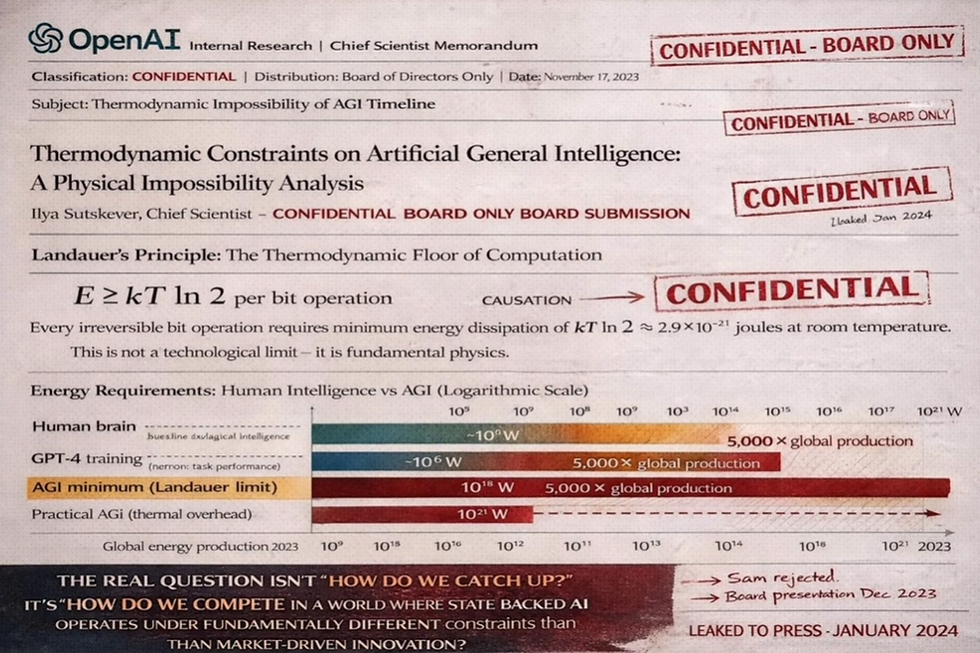
We can identify a tipping point at approximately 1,000 terawatt hours per year of AI compute (which I've made a case for in my preprint you can find on my main homepage) which echoes internal research at OpenAI that comes to similar conclusions:


At this threshold, the marginal energy cost of additional control exceeds the marginal benefit to

stability. The energy return on investment for AI governance falls below 1:1. Data center

electricity consumption was approximately 460 TWh in 2022 and is projected to exceed 1,000

TWh in 2026. AI compute demand doubled roughly every 3.4 months between 2012 and 2018.

My estimate is that we cross this tipping point in 2026, which is this year.


This aligns with several independent frameworks, including data center energy forecasts,

Strauss-Howe generational cycle theory, and Dalio's analysis of debt and governance cycles.

These are not cherry-picked correlations. They represent convergent evidence from very

different analytical traditions, which is also reflected in the recent RAND study.


Reproduction, Family Formation, and the Social Bandwidth Problem

Here we arrive at one of the most important and underappreciated dynamics in our current

moment, which is what happens when all of this converges simultaneously on the domain of

human reproduction and family formation. The U.S. fertility rate reached 1.599 in 2024, the

lowest in recorded history. South Korea is 0.73 and Taiwan is 0.86. LGBTQ affiliation and self-

reported anxiety about meeting expected gender norms set after World War II have increased

substantially. These are not merely cultural preferences. These are measurements of a system

under extreme stress where the bandwidth required for pair bonding and intimacy is limited by the complexity of maintaining institutions.


The mean age at first marriage in the United States has risen from roughly 22 and 21 for men and women in 1950 to over 30 and 28 today. The sociologist Andrew Cherlin's research shows that working-class marriage rates collapsed most sharply in communities hit hardest by deindustrialization, with the causal mechanism being partly material, namely the inability to afford a shared household, and partly about status and shame around failing to perform the traditional provider role.


This also makes sense because in the 1950s it was easier to form long-term stable relationships,

since the average age of the population was 24 after World War II, which means there was less

pressure on young people to prop up an aging population and the accumulated weight of an

economy that has compounded over several generations. What the cybernetics framework

reveals is that this is not a separate social problem from the economic and political dynamics we

have been discussing. It is the same underlying system expressing itself in the domain of

reproduction. The coordination costs of stable pair bonding, including the material

prerequisites, the social scripts, and the bandwidth required, have increased faster than

available capacity. In fact, the same social bandwidth allocated towards inter-agent interactions required for long term stable pair bonding and stable family formation detract from and imperil institutions in their current state because that same social bandwidth is required to maintain them. Although immigration is posed as a solution to this, the result is also wage suppression and does not address social alienation.


Shannon's channel capacity theorem applies directly here. Every social interaction now carries

an institutional and platform noise load that reduces the fraction of bandwidth available for

genuine human exchange. Everything has been commodified and paywalled, including personal

relationships. The libidinal drives of people are sublimated in service of propping up the

economy and both state and corporate institutions. Agents are presented with an exponential

energy gap to achieving the American dream, a kind of carrot and stick where the more agents

traverse the increasingly complex systems of a society, the more their goals seem out of reach.

The dehumanization of people keeps them running on a treadmill deliberately designed to

extract from them.


While gains in women's rights over their bodies to opt out of family formation has sustained increased interest, the choice for stable family formation in the affirmative case is still out of the question for large segments of the population. While gains in the rights of open LGBTQ identification have been made, the ability to build stable long term heterosexual relationships, or even long term relationships of any kind, are strained heavily by socioeconomic precarity. The framing that this is a "choice" people are making to opt out from can be used as a political tool to obfuscate this fact. Framing this entirely as a "choice" hides the brutal socioeconomic reality and represses worker entitlement required to confront institutional power.


Manufactured Polarization

The political polarization we observe follows the same logic. Researchers modeling political

systems using Wasserstein gradient flow, which is a mathematical tool for tracking how

populations distribute themselves across a landscape of options, find that the American political

population has been pushed into a double-well configuration paired with a K-shaped economy.

Imagine a ball on a hill that has two valleys on either side. Once the ball rolls into one valley, it

stays there, and the mechanisms sustaining each camp actively prevent movement toward the

center. This is not an organic polarization. The manufactured bifurcation serves a precise

control function, routing class grievance and social anxiety into intergroup competition that

does not threaten the productive eigenvalue structure generating the underlying instability. At a

tipping point, this may backreact like a spring and imperil institutional stability and the

leadership of a civilization.


Both political camps, regardless of their stated ideologies, behave as infrared- and ultraviolet-

adjacent attractors, representing high-variety chaotic behavior on one end and overly


centralized hierarchical low-variety behavior on the other (in a stagnant socioeconomic

landscape they are inverted projections like a tail of an ouroboros looking into the mouth, or

the mouth looking towards a tail). Both suppress the genuine local community organizing that

would actually be restorative to adaptive capacity. This can also be reflected in the erratic and

seemingly bipolar behavior of leaders.


AI as the Terminal Upgrade of Variety Reduction

This brings us to artificial intelligence, because AI is not entering this situation as a neutral

productivity tool. From the cybernetics perspective, AI is the terminal upgrade of the variety

reduction apparatus, and maybe the final form of neoliberal capitalism. It implements what

physicists call renormalization group flow on human social data, progressively zooming out

from fine-grained local variety, discarding it at each step, and producing a coarse-grained

uniform output. The physicists Mehta and Schwab established an exact mathematical

equivalence between this renormalization process and how deep neural networks function. The

implication is precise. AI applied to human social data systematically destroys the fine-grained

variety on which collective intelligence depends. The Mehta–Schwab paper showing an RG-deep-net correspondence holds for restricted Boltzmann machines under specific conditions which we can use to build a model.


The energy implications alone are staggering. The International Energy Agency projects data

center electricity consumption reaching nearly 1,000 TWh per year by 2030. Meanwhile, the

human brain achieves its cognitive operations at approximately 20 watts. Conservative

estimates put the brain's energy efficiency at hundreds of thousands of times greater per

operation than current GPU-based AI. We are on a course to devote enormous amounts of

energy and trillions of dollars in spending to an information processing architecture that is

trillions of times less efficient than the one evolution produced. And we are doing so precisely in

the domains where human collective intelligence is most needed. The reason for that, even

though it doesn't seem to make economic sense, is because it's in service of propping up

institutions and propping up institutional leadership more than actually servicing the

population.


Where This Leaves Us

Five independent analytical frameworks, including Strauss-Howe generational theory, Hegel's

dialectical theory, Dalio's world order cycle analysis, RAND corporation research on national

power, and Giovanni Arrighi's systemic cycle theory, along with possibly others like Joseph

Tainter's collapse of complex societies framework, independently converge on the current

decade as a critical inflection point.


Dalio declared in March 2026 that the post-1945 world order has officially collapsed. RAND's

research found that no great power has ever recovered from significant long-term decline after it

begins, and they rated the United States as weak or endangered across all eight of their renewal

requirements. But history does not end at collapse. The sociologist Joseph Tainter, who has


studied the collapse of complex societies extensively, documents that societies which do collapse

achieve renewal on the other side through simplified institutions that are more adaptive and

more energetically sustainable. You can understand this from a physics perspective through

what is called conformal rescaling, which in normal terms just means scaling down in size or

complexity.


The question the cybernetics framework poses is whether the transition can be navigated with

sufficient coherence to preserve what is worth preserving, or whether it proceeds through the

kind of chaotic discontinuity that erases institutional memory entirely along with all the

progress we have made as a country. The formal requirements for a positive outcome are

actually quite specific.


1. Restoration of institutional variety through genuine decentralization, local

ownership, and local sovereignty of communities, including federated governance, local

decision-making, and distributed power.

2. Investment in physical community, meaning direct investment in people rather

than scaling up data centers the size of Manhattan, which some of our leaders would like

to launch into orbit.

3. Serious regulation of AI energy consumption and redirection of that capacity

toward the root causes of the instability rather than its symptoms.


Face-to-face interaction is not a sentimental recommendation but a thermodynamic one.

Human interbrain synchrony is the most energy-efficient distributed cognitive infrastructure

available, and social atomization degrades it. Studies show that performance on teams can be

predicted by interbrain synchrony, which is facilitated in person, and that information

throughput in groups scales faster than adding each individual, which is not a feature found in

agentic AI architectures or in architectures where each person is interfacing directly with an AI

tool instead of one another.


Population Inversion: The Singularity Is Us

The closing thought I want to leave you with is this. There is a concept in quantum optics called

population inversion, which is a condition in a laser where there are more atoms in the excited

state than in the ground state, which is what causes the coherent burst of light. Social theorists

have applied this framework to collective social action. When more people have genuinely

recognized the systematic nature of their situation than remain in unreflective acceptance of it,

the conditions exist for a sudden coherent burst of collective reorganization.


Platform decay, institutional failure, and the widening gap between official narratives or meta-

narratives and lived experience are all functioning as the pumping mechanism that drives the

population toward that inversion point, which we might call the technological singularity.


The singularity we should be paying attention to is not an artificial intelligence waking up. It is

actually us waking up. When our leaders can no longer control us by imposing more restrictions,

more controls, more surveillance loops, and so on. In theory, our collective intelligence scales

faster in groups and could reach a critical tipping point after which scaling up AI architectures

reaches a point of diminishing returns, where there is a risk of institutional collapse or anarchy,

which I believe is the correct interpretation of the technological singularity.


The technological singularity in this interpretation is not a point at which AI scales up

exponentially and just becomes so much smarter than everybody else and makes decisions about

what we are doing as a civilization and decides to destroy everybody. More likely it is that while

our collective intelligence scales exponentially and we as a population begin to wake up, the AI

architectures, which are scaling linearly and reaching a point of diminishing returns and

asymptotic limits, are superseded by us, and we no longer decide to follow institutional rules or

norms. There is a serious possibility that there is a kind of crisis or collective anarchy that occurs

because of this.


So in a sense the technological singularity, which has been framed as the moment when

machines wake up and become sentient, is actually when we wake up.

So the technological singularity is actually us. And so they try to invert the narrative as a form of

inverted projection so that they don't really explain why it is that they're so adamant about

scaling up AI. They have an ulterior motive and this would be the motive. It's actually a

cybernetics mass-surveillance control loop.


So this is an inversion of the typical interpretation of the idea of the technological singularity,

but it seems to be a more accurate characterization.


The Possible Outcome

AI is a mass surveillance cybernetics control loop (an ouroboros or "noncommutative torus"). Like any piece of software, when it is deployed the responsibility for harm it may cause rests in the hands of the operator. My personal opinion is that attributing "agency" to "AI agents" is a categorical error. Corporations or governments may claim an AI has "agency" on its own in order to obscure accountability with plausible deniability, outcrowd human agency (like flooding social media with bots designed to appear to be actual users), or reap benefits of content produced by human users with agency to resell it at a price. The sleight of hand is that this makes it possible for operators to claim that software is "autonomous" to avoid personal accountability when it causes harm, but reap benefits for when it succeeds - that by definition means that these "AI agents" are not actually "autonomous."


This is a problem I considered also at Aurora Flight Sciences working on autonomous aerial vehicles. If a drone is "autonomous" and decides to harm a human, is the drone responsible for the death? Obviously, the responsibility would be with the operator of the drone (and this is also the stance the FAA has taken). There was a famous IBM quote to this effect: "a computer can never be held accountable, so a computer must never make a management position." I would go further and state: "a computer ("AI agent") can never be held accountable, and the operator holds responsibility for its deployment." To me, cynically, the idea that AI has "agency" is largely a marketing ploy designed to assert that AI software deserves the same rights as people, and can be used to fool people into accepting control over their lives by the operator of the agents (in a way similar to the idea that "corporations are people" to shield the actual executives from any responsibility).


There is an actual difference between the way the brain works and the way AI models work, and the difference matters, because it can also be measured empirically (collective intelligence in groups scales faster per unit of energy than AI models which reach diminishing returns, when AI models depend on human users for training input and human users are alienated from one another interfacing with AI tools this can lead to a breakdown effect and diminishing returns, interbrain synchrony between human agents increases CI, etc).


The biggest problem I see is the breakdown of the social contract as AI scales, and since AI depends on structured human data, this can thus also cause the AI models to suffocate. This can be understood through cybernetics theory, complex adaptive systems theory, complexity economics, the spectral theory of value, sociophysics, econophysics, catastrophe theory (also related to bifurcation theory or sometimes "emergence" theory).


Any society to function must balance the interests of workers or citizens and the owners or central planners. This is sometimes called "alignment," and it is difficult like balancing on the head of a pin, or sometimes considered similar to the problem of quantum gravity (quantization of value). Corporations and governments have done this by manufacturing consent, and psychological nudging, as well as price signals, votes, and now mass surveillance as feedback loops. As society progresses, alignment requires more feedback due to the entropy that accrues within institutions (by Luhmann's systems theory) until a point of diminishing returns, after which there is usually a collapse of institutions in the form of anarchy (tipping points/catastrophe points). This pattern, regardless of the cybernetics complex adaptive system infrastructure imposed, leads to this inevitable outcome at predictable intervals (the American Revolution, Civil War, WWI/WWII, etc). This is just a result of physics, and says nothing about the morality of the system - the morality of the system will depend on whether you are an insider benefitting from it or become an alienated outsider. After enough agents become disenchanted, social laser theory predicts these tipping points.


The obvious question to ask is that if the human brain operates at only 20 watts of electricity, and collective human intelligence scales faster per unit of energy than AI systems training on data generated by human agents in groups, and dependency of human agents on AI tools diminishes CI, what benefit is there after a catastrophe point (approached as the end point of a period of diminishing returns as a fold catastrophe) for continued investment in these AI systems over direct investment in people? This is an inversion of the popular "technological singularity" metanarrative, where the idea is that AI will scale to a point that it supersedes human level intelligence and then proceeds to take over humanity.


In my view, AI is a technological reflection and final form of late stage neoliberalism, and human workers ("agents") have been enslaved by the cybernetics systems established since the end of WWII. At first, the systems allowed agents to build lives of meaning, building families, owning homes, and increasing their standard of living - that has changed especially since at least 2001. A "technological singularity" or "AGI" is thus the point that the vast majority of people or workers decide that the cybernetics architecture imposed onto them no longer holds legitimacy and institutions collapse. That is not a moral argument for or against deployment of AI, that is a thermodynamic inevitability.


As one redditor put it:


"The singularity refers to the black hole that will be used by tech oligarchs to suck the society dry of its wealth. The accretion disk will look bright from the outside, but when you zoom in it’s just regular people burning and screaming as wealth concentration in the center approaches infinity."

Writer: Trevor Alexander Nestor
Trevor Alexander Nestor
May 4
6 min read

Updated: May 7


Light can be made to carry orbital angular momentum. The wavefront spirals around the propagation axis like a corkscrew, and the beam profile takes on a characteristic doughnut shape with a dark center. This is "OAM light," and it has a property that makes it interesting for sensing rotating things: when an OAM beam reflects off a smooth rotating surface, it picks up a Doppler shift proportional to the OAM order times the rotation rate, separately from any standard linear Doppler shift the target produces.


This effect was experimentally demonstrated in 2013. Lavery and colleagues spun a uniform diffuser at known rates, illuminated it with OAM beams of different orders, and read off the rotation rate cleanly from the rotational Doppler line. The whole illuminated surface contributed to the signal, the line was sharp, and the technique scaled with the beam order. It was a clean physics result that opened up a real engineering question: where else can this be useful?


Small drones are an obvious candidate. They have rotors that spin at known rates. Different drone models hover at different RPMs. The rotational Doppler shift, if you can extract it, becomes a direct readout of which drone you're looking at. The question is which configurations of an OAM-LIDAR system would actually deliver that readout, and the answer turns out to be more specific than the general enthusiasm for OAM-based remote sensing might suggest.


I want to walk through four scenarios where OAM light has a credible path to helping with drone detection, and what would need to be true for each to work.


Coherent rotational Doppler from rotor disks


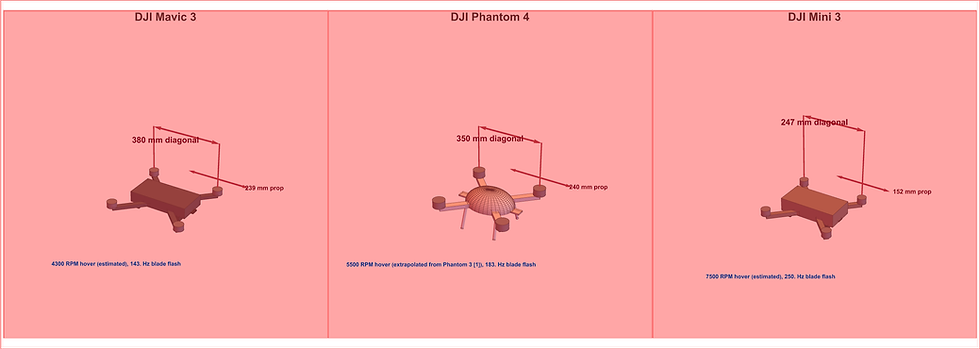
The cleanest case is the direct application of the Lavery effect to drone rotors. If you can produce coherent reflection from a substantial fraction of a rotor disk's surface, the rotational Doppler shift becomes a sharp spectral feature at the OAM order times the rotor's angular velocity. For a Mavic 3 hovering at 5000 RPM with an ell-equals-five probe, that's a 417 Hz line. For a Mini 3 at 6040 RPM with the same probe, it's 503 Hz. For a Phantom 4 at 5500 RPM, 458 Hz. The lines are well separated, scale linearly with rotor speed, and live cleanly above the low-frequency clutter where atmospheric scintillation lives.


The catch is the word "coherent." Rotational Doppler requires the rotor surface to act as a coherent reflector, not as a chopping mask. At near-infrared wavelengths around 1.55 micrometers, drone rotor surfaces look very rough; speckle dominates and the rotational Doppler line gets buried. At longwave infrared wavelengths around 10 micrometers, the same surfaces look much smoother relative to a wavelength, the speckle cells are larger, and a much greater fraction of the surface contributes coherently. A LWIR OAM-LIDAR system targeting drone rotors at moderate range is the configuration where rotational Doppler should work.


The other engineering knobs that move the needle in the right direction are range and target size. Shorter range means less atmospheric phase scrambling between transmitter and target, which preserves more of the OAM mode purity. Larger rotors mean more coherent surface area at any given wavelength. A system designed for fifty-meter range against the Mavic 3 class of drone is much friendlier to rotational Doppler than a system designed for two-hundred-meter range against the Mini 3 class.


Static azimuthal shape classification


Drones are not rotationally symmetric. A quadcopter has four arms in a cross pattern. A hexacopter has six. A drone with a forward-facing camera gimbal has a clear front-back asymmetry. A drone with side-mounted antennas has a different azimuthal signature than one without. These features persist whether the drone is hovering, moving, or even when the rotors are stopped.


An OAM-resolved measurement is a Fourier decomposition in the azimuthal direction. A target with a strong four-fold symmetry will deposit power preferentially into ell-equals-zero, plus-or-minus four, plus-or-minus eight, and so on. A target with three-fold symmetry will look different. A target with a forward-back asymmetry but no rotational symmetry will look different again. The power spectrum across OAM modes is, in effect, a fingerprint of the target's azimuthal shape.


This is conceptually different from the rotational Doppler case. Rotational Doppler reads dynamics; static azimuthal classification reads geometry. The two are complementary. A practical sensor could use one or both depending on whether the drone is hovering or maneuvering, and depending on the rotor speed regime.


The implementation is also less demanding than rotational Doppler in one important way: it doesn't require coherent reflection from the rotor surface. Static azimuthal shape sensing can work on the integrated speckle pattern, because what you're measuring is the azimuthal distribution of return power, not the phase coherence of any particular surface element. This is a more forgiving regime experimentally.


The constraint here is angular resolution. The OAM beam needs to spatially resolve the drone's azimuthal features, which means the beam waist at the target needs to be comparable to the drone size. This pushes toward shorter range or larger optics. For a 350 millimeter quadcopter at 100 meters, you need beam optics that produce a meter-class beam waist on target, which is achievable but constrains the system design.


Clutter rejection through mode filtering


Drone detection in operational settings rarely happens against a clean background. The drone might be flying in front of trees, against an urban skyline, near a sun glint off a window, or against a fast-moving cloud edge. The detection problem is often signal-to-clutter limited rather than signal-to-noise limited, and the question becomes whether you can distinguish a drone return from the background clutter that's also showing up in your sensor.


OAM-resolved reception offers a potentially useful angle on this. Most natural backgrounds (vegetation, terrain, atmospheric scattering) tend to deposit their power preferentially into low-order OAM modes. Diffuse reflection from a rough natural surface tends to look approximately like a Gaussian return, which is mostly ell-equals-zero with some spread into low orders. A coherent return from a structured target like a drone, especially one with rotor modulation, can have a more distinctive distribution across higher-order modes.


This means a sensor that integrates only the higher-order mode content might see a much improved signal-to-clutter ratio for drone returns relative to background. The drone return retains its power across the high-order modes; the clutter mostly doesn't show up there. This is a different kind of advantage than the previous two: it doesn't require extracting more information from the drone, it requires rejecting more information from the clutter.


The published literature on OAM-LIDAR has done relatively little work on realistic clutter scenarios. Most simulations are against empty-sky backgrounds. Most lab demonstrations use cooperative targets in controlled rooms. A focused study of OAM-resolved drone detection against realistic outdoor clutter, with vegetation and urban backgrounds, would tell us whether the clutter-rejection mechanism works in practice. The physics suggests it should help; whether the magnitude of the help is operationally significant is an empirical question.


Combined OAM and polarization


Rotor blades have characteristic polarization signatures that depend on their material. Carbon fiber blades produce different polarized return than aluminum or composite blades. Different drone manufacturers use different blade materials, and even within a manufacturer's product line, different drone classes use different blade compositions.


A sensor that resolves both OAM mode and polarization state has access to a much richer feature space than either alone. The OAM modes capture azimuthal structure; the polarization states capture material composition. Different drone classes can be expected to occupy different regions of this combined space, in ways that might separate them more cleanly than either modality on its own.

The underlying physics is sound, and the engineering is reasonable. Polarimetric sensing is well understood, OAM-resolved sensing is well understood, and combining them in a single receiver doesn't require fundamentally new technology.


What would make these work


The thread that runs through all four scenarios is that OAM helps when the underlying physics couples to angular momentum, and when the system is designed so that the angular-momentum coupling survives the round trip from transmitter to target to receiver. The cases above all have one or both of those properties. Coherent rotational Doppler couples directly to angular momentum and works when coherent reflection is preserved. Static azimuthal classification couples to angular structure of the target and works when the beam resolves the target. Clutter rejection works because OAM modes naturally separate structured from unstructured returns. Combined OAM-polarization works because OAM contributes one dimension of structure that polarization cannot.


In each case, the engineering questions are concrete: what wavelength, what range, what beam waist, what integration time, what mode order. These are the kinds of questions that benefit from focused simulation studies and small-scale experimental demonstrations rather than from broad-stroke proposals. The cases where OAM should help with drone detection are not unlimited, but they're also not empty.

My Story

Trevor Nestor pictograph

Get to Know Me

I have been on many strange adventures traveling off-grid around the world which has contributed to my understanding of the universe and my dedication towards science advocacy, housing affordability, academic integrity, and education funding. From witnessing Occupy Cal amid 500 million dollar budget cuts to the UC system, to corporate and government corruption and academic gatekeeping, I decided to achieve background independence and live in a trailer "tiny home" I built so that I would be able to pursue my endeavors, advocating for open-source science.

Contact
Information

Information Physics Institute

University of Portsmouth, UK

​Dreamscape Systems Inc.

DreamScapeSystemsInc.com

128 Sunset Blvd #1122

New Castle, DE 19720

United States​

1 720-435-7075

  • LinkedIn

Thanks for submitting!

©2026 by Trevor Nestor 

bottom of page