"Post-Quantum Cryptography" Is Not Secure

Updated: May 29
A presentation on lattice-based cryptography, the shortest vector problem, and its surprising
connections to consciousness, biophotons, and the black hole information paradox.
Video presentation: https://youtu.be/jSqeYz8Wh-Q
Introduction
Today I would like to present on the topic of possible vulnerabilities of post-quantum
cryptography to emerging physics beyond the standard model. This is a controversial topic I've
thought deeply about for the last 15 years, going back to when I was a student of Fields Medalist
Dr. Richard Borcherds at the University of California, Berkeley, who specializes in lattice
mathematics and string theory and is famous for solving what is called the monstrous
moonshine conjecture. It isn't clear to me why this presentation is banned from both Reddit and LessWrong, it's pretty trivial to both check citations and also show it's not AI generated (the video presentation where most of this is extracted transcript directly from this article is in my natural cadence, and I was working on these opinions even before LLMs became mainstream though admittedly sometimes I use it for formatting - maybe more evidence that academia, science, and technology have become more of an orthodoxy like a religion - like a pyramid scheme of interlocking monetary incentives that seeks to repress outside thought?).
The Baseline Assumption, and the Surprise
We start with the base assumption that in the next few years quantum computing is likely to
imperil our current cryptographic standards. This is what prompted the National Institute of
Standards and Technology in 2018, when I was visiting Boulder, Colorado, to evaluate newer
standards that are supposedly resilient to both quantum and classical attacks:
The resilience of post-quantum cryptography to both quantum and classical computers has
never been fully proven. In fact, one of the candidates for post-quantum cryptography, known as
SIKE, or supersingular isogeny key encapsulation, surprised the entire cryptographic
community when it was cracked within only 62 minutes on a standard Intel CPU.
Post-quantum cryptography is based largely on what are called lattice problems and the
difficulty of resolving what is called the shortest vector problem over a high-dimensional lattice,
or its close geometric equivalent, the non-commutative torus. SIKE was isogeny-based, not lattice-based. Its break (an algebraic attack using Kani's theorem on abelian surfaces) has no implication for the security of ML-KEM/Kyber or other lattice schemes, but we can think of it as a motivation to consider that reality itself may prove to be less predictable than mathematicians or cryptographers have assumed.
My own personal view has always been that any truly unbreakable encryption is too hubristic a
request of the universe, and there is a pattern of nature surprising us and collapsing even our
strongest assumptions. So while this problem seems impossible from the perspective of classical
attacks from any classical physics, and from the perspective of quantum attacks from quantum
physics, there is one emerging area of physics, at the intersection of classical and quantum
approaches, or physics beyond the standard model, that has evaded much attention.
Three Problems, One Shape
The NP-hard shortest vector problem, where NP-hard is a classification of computational
complexity, is related to the so-called learning with errors problem. That problem is needed to
understand how the brain efficiently achieves the equivalent of backpropagation, and also what
is known as the perceptual binding problem, which is the problem of how the brain binds
sensory features into coherent experiences. Cryptography uses approximate-SVP, which isn't known to be NP-hard in the relevant approximation regimes; in fact, gap-SVP at the parameters used is in NP ∩ coNP and unlikely to be NP-hard, but lattice crypto's hardness assumption is weaker than people sometimes imply when they wave around "NP-hard." Only exact SVP and SVP with small approximation factors are NP-hard, which is a stronger problem we are going to think about where lattice problems are thought to be intractable under worst case assumptions.
The perceptual binding problem was mapped to the shortest vector problem by researchers like
Tsotsos, and brain neural networks have been mapped to high-dimensional lattices and non-
commutative tori in academic literature by groups like the Blue Brain Project. More recently
some have (unconvincingly) contested Tsotsos' work, proposing that the way in which the brain
achieves perceptual binding is by so-called "predictive coding." Strictly hierarchical or merely approximate models of perceptual binding, however, (like predictive coding) assume that the
brain successively pools local features into ever more complex conjunctions until a unified
object code emerges. Empirical evidence now shows this feed-forward scheme is insufficient:
MEG and fMRI reveal that the moment at which features are bound coincides with the onset of
late, recurrent activity that re-enters early visual areas, and when these feedback loops are
disrupted pharmacologically or with Transcranial Magnetic Stimulation (TMS), illusory
contours, perceptual switching and contextual grouping all collapse even though the putative
"higher"; hierarchical stages remain intact.
Tsotsos mapped visual attention complexity to an NP-hard problem in a computational-complexity sense which is exactly what we are referring to here.
The shortest vector problem has also been tied to the black hole information paradox in
academic literature, because on the surface, the black hole information paradox is a kind of
cryptographic question involving the flow of information one way across an event horizon, but
somehow this information must escape in some scrambled fashion from the black hole to
preserve information unitarity, which quantum theory demands.
So there is a kind of near equivalence between these problems. Post-quantum cryptography, the
black hole information paradox, and the way in which the brain processes sensory information
and binds it into a coherent experience. At least as a starting point, in theory it might be possible
to use cultures of biological neurons stimulated to encode a lattice problem to somehow retrieve
the shortest vector over that lattice, and understanding the physics of this may shed some light
into the black hole information paradox, at least from what we know so far.
As a brief aside, this might even shed some light on the physics of collective behaviors of people
in social networks, since we know that brain activity synchronizes across individuals in a group,
that collective intelligence seems to scale faster in groups than adding individual intelligence
together, and that more controversial theories like so-called social laser theory, which I admit
sounds somewhat strange, attempt to explain the sudden emergence of macroscopic quantum-
like collective behaviors in groups of people. In cybernetics theory, social networks of people are
much like brain neural networks, where one-way flows of information in the form of transactions between social and economic institutions often backpropagate in the form of
unpredictable behaviors.
The Proposed Experiment
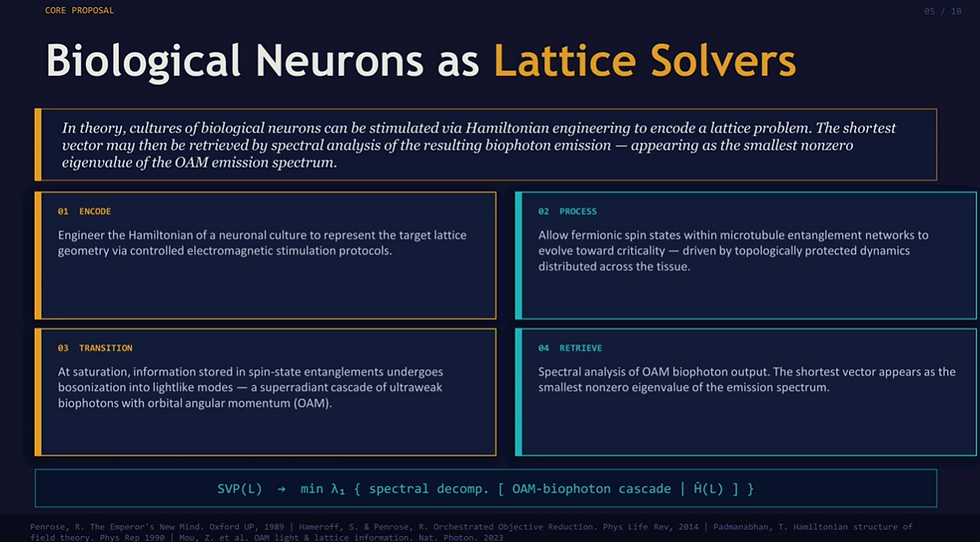
So let's say we have a culture of biological neurons and we train these neurons to represent a
lattice problem, which we can theoretically do by Hamiltonian engineering. How can we retrieve
the shortest vector over that space?
There is a good amount of evidence mounting that underneath the neural network layer in these
tissues, within neuronal cytoskeletons, there are long cylindrical proteins called microtubules,
which host topologically protected fermionic spin states. The reason the brain is so efficient at
compute, operating on only about 20 watts of electricity when compared to the supercomputers
we have (the ones many tech leaders would like to power with their own dedicated nuclear
power plants) is because this physics is much more efficient than what is facilitated by
electrochemical signaling alone.
Within these microtubules are supposed to be entangled networks of these fermionic spin states
distributed across the tissue. The idea is that they are driven or orchestrated to a point of
saturation, and then at a critical phase transition, the information stored within the
entanglements of these spin states gets bosonized into light-like modes.
In experiments what this looks like are superradiant cascades of ultra-weak Majorana-like
vortex biophotons, or biophotons with a quantum property called orbital angular momentum,
and other possible forms of structured light (such as Skyrmions or Hopfions) which carries the
information that was stored in these spin states. At critical points, the superradiant cascades
broadcast error backpropagation across the brain tissue, and account for perceptual binding.
Experiments have demonstrated these superradiant cascades and even that light can modulate
long-term potentiation and long-term depression in neuron cells.
In theory, then, it should be possible to extract the shortest vector over our lattice space by
spectral analysis of this light, where the shortest vector should appear as the smallest non-zero
eigenvalue. Recent work has also shown that OAM light is capable of storing information about
the high-dimensional lattice geometries that would be needed.
What Evidence Do We Have?
So what evidence do we have of this supposedly niche, fringe theory? It turns out there has been
quite a lot of evidence accumulating over the years.
First, experiments done with xenon anesthetics blocking microtubule channels showed that the
isotope of xenon used modulated anesthetic potency, suggesting that the quantum property of
spin might be implicated in the way the brain processes information through what is called the
radical pair mechanism.
We also know that the speed and efficiency of the brain cannot fully be accounted for by
electrochemical signaling, and that information is non-locally distributed across the tissue,
which is stored and retrieved much differently than what you would see in a von Neumann
architecture.
Studies of microtubules show resonance frequency peaks across scales consistent with
conformal field theories, and even time-crystalline behaviors, which could be implicated in the
way microtubules facilitate backpropagation. The idea here is that fermionic, possibly Majorana-
like spin states might be hosted within the hydrophobic pockets of microtubules, and the
information might be bosonized into these superradiant cascades, where the microtubules act as
optical waveguides.
Microtubule theories of consciousness or brain function have been criticized because they
sometimes implicate what seem like bizarre ideas of quantum gravity or macroscopic quantum
entanglement, and don't appear to be viable based on what most of us are taught about physics.
Newer investigations and research call these assumptions into question, and there has even
been an emerging field of quantum biology, which indicates under-examined quantum effects
are required to explain phenomena like cellular signaling, photosynthesis, avian navigation,
sensory olfaction, and even human behaviors, which in studies seem to follow interference
patterns like quantum decision trees.
The Mathematical Framework
The mathematics of this can be understood with twistor theory, which describes null light
geodesics, and Einstein-Cartan theory, where these null light geodesics describe spacetime
torsion. In string theory, information carried in the form of light with orbital angular
momentum is sometimes referred to as "soft hair," and is implicated in one theoretical angle for resolving the black hole information paradox.
The transition of information stored in the form of entanglements of fermionic spin states,
sometimes called hidden islands of entanglement entropy in the literature, to these light-like
modes in superradiant cascades can be understood with Z2 orbifolds, and the behavior at the
phase transitions can be understood with the Riemann zeta function.
In fact, there have been many recent studies that were able to replicate the zeros of the Riemann
zeta function by periodically driving qubits, and models that explicitly link the Riemann zeta
function to the behavior of Majorana spin states in curved spacetimes, which can be simulated
in these environments. Both of these results demonstrate a possible resolution to the so-called
Hilbert-Pólya conjecture, which poses the possibility that the zeros of the Riemann zeta function
might eventually prove to be observed as the energy levels of some quantum physical system.
The Riemann zeta function has also been linked to macroscopic quantum-like physics such as
fluid turbulence, quantum chaos, and phase transitions in nonlinear systems theory. Similar experiments have also approached the shortest vector problem by means of spin glasses and
folded spectrum methods.
The Penrose-Hameroff Model
According to Dr. Penrose and Dr. Hameroff's model, this phase transition is facilitated by
gravity itself. At this critical point, macroscopic quantum superpositions and entanglements of
these spin states are orchestrated and saturate a complexity bound, possibly into what are called
Fröhlich condensates, after which the information content stored in these entanglement islands
or entanglement wedges is discharged in what is called an objective reduction event through
these superradiant cascades, which are a macroscopic quantum-like behavior, with gravitational
feedback that adjusts dendritic weights and facilitates learning in neural networks.
This is supposed to be the solution to the measurement problem, and one angle for explaining
why the world around us does not appear in a superposition. Whether this explanation pans out
will require further empirical study. It is conceivable that the information about a black hole
interior may escape encoded in a similar fashion and printed on light with orbital angular
momentum that might be investigated by spectral analysis.
Why This Matters
Regardless of what you think about this controversial physics, it is under active investigation by
top scientists, academics, corporations, and governments, where it has been taken very
seriously. You might think this is just a fringe theory. You can go ahead and think that, but you
might be left behind.
Whether or not these theories pan out, this is a road map for further investigation and fuel for
our skepticism of the claims made about the supposed resiliency of post-quantum cryptography,
or the viability of our artificial intelligence architectures, where it may actually prove to be more
economical to invest directly in people and communities than in AI data centers.
In conclusion, it is possible that the next breakthroughs in artificial intelligence and
cryptography might not come from scaling up data centers with their own dedicated nuclear
power plants the size of Manhattan and sending them into orbit, as many of our tech leaders
suggest (sort of a crazy idea), which strain our resources or require millikelvin temperatures
with gold-plated nanowires to manipulate qubits. They might come from a greater
understanding about what makes us human, and the physics for how our brain works and
extends to others and within our communities.


Comments