The MILLENNIUM Project

Updated: Sep 24

Several of the hardest open problems in mathematics and physics have begun to resemble one another, and nobody has yet checked whether the resemblance is real. That question is the whole of the MILLENNIUM Project.
Years ago I noticed that the plasma streamers from tesla coils could produce arcs which are fractals - and in some cases, could even produce arcs that resembled spears - completely linear - without bifurcations or the characteristic jagged geometries you would expect from lighting (when driven by vacuum tubes). This was strange to me because I initially thought that the geometry of the arcs was due to the ionization paths of particles carved out along the way. It turns out that turbulent fluid also produces these fractal patterns, and the statistics resemble what you get from the Riemann zeta function (something physicists like Dr. Migdal have written about).

Start with turbulence. Stir cream into coffee and energy moves from large swirls into smaller ones, over and over, until it dissipates as heat. The cascade is not gentle. Most of the violence concentrates into a thin, tangled set of regions while the rest of the fluid stays comparatively calm. Physicists capture that lumpiness with a single curve called the exponent function, which records how the statistics change as you look at higher and higher powers of the field. The shape of that curve is a fingerprint of the underlying mechanism which appears in a fractal across scales.
The object that controls where the branch goes next in a tesla coil streamer is the harmonic measure on the boundary of the existing structure, and harmonic measure on a rough boundary is multifractal. That multifractal spectrum is the same kind of curve MILLENNIUM measures in turbulence. The bridge to Gaussian multiplicative chaos is exact in one setting only. For conformally invariant random curves in two dimensions, Duplantier computed the harmonic measure multifractal spectrum using quantum gravity methods, and Duplantier and Sheffield later proved the KPZ relation rigorously with Gaussian multiplicative chaos as the underlying object.
This is important to understand because the control of plasmas and turbulent chaos could be instrumental in tokamak fusion or assist in understanding the physics of corona ejections.
Now move to a subject with no fluid in it at all. The Riemann zeta function, the object at the center of the most famous unsolved problem in mathematics, produces a jagged landscape of peaks and valleys along a particular line in the complex plane. Over the past fifteen years, mathematicians have shown that the extreme peaks of that landscape follow the same statistical law that governs certain random cascades. The zeta function has a fingerprint or spectrum too, and it looks familiar.
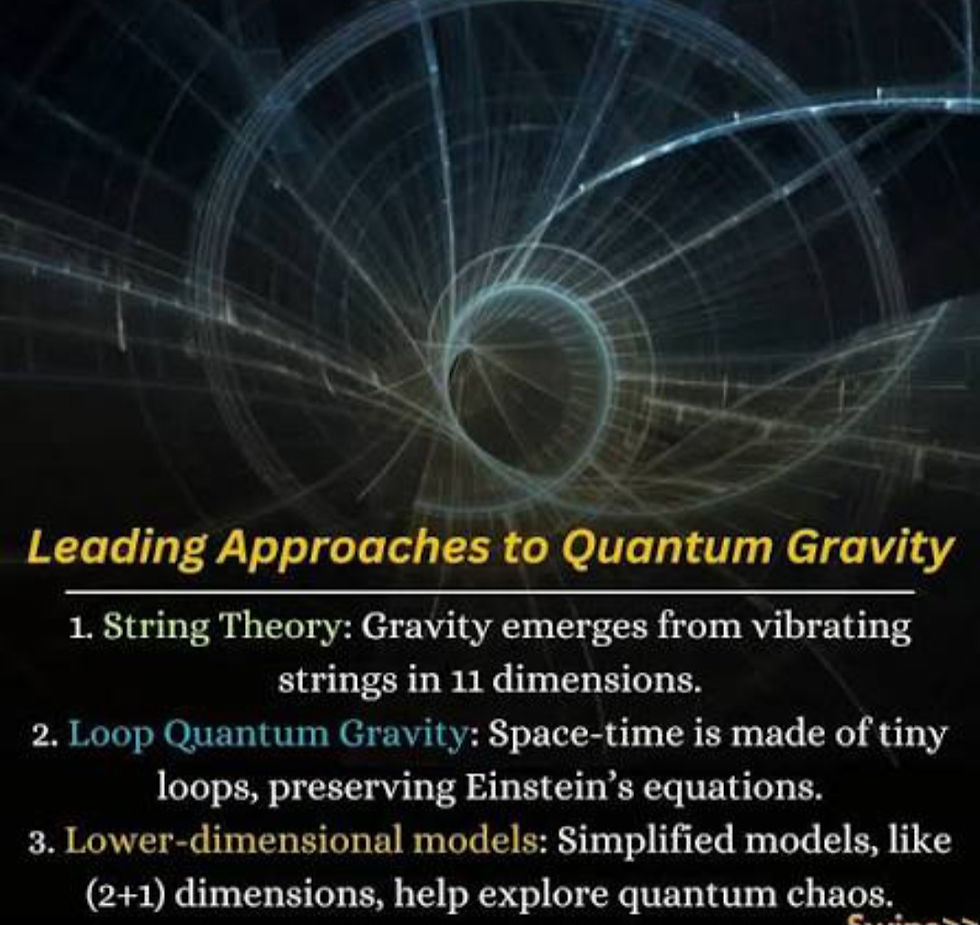
Three more subjects carry the same marking. Large random matrices, which have described the energy levels of chaotic quantum systems since the 1980s, show a sharp transition where their statistics change character at a critical point. Majorana systems with random couplings, the ones that have become a laboratory for quantum chaos and black hole physics, show related structure in their spectra. And two dimensional gravity, a simplified model of curved space where mathematicians have proved things they cannot yet prove about our own four dimensional universe, produces the same curve in exactly solvable form.
One candidate explains all five. It is a probabilistic object called Gaussian multiplicative chaos, and its signature prediction is unusually sharp. If it is the shared mechanism, the exponent function must be a parabola over a certain range and then a perfectly straight line beyond a critical point. Not approximately a parabola. Exactly one.
Dr. Migdal has another approach where he links the Riemann zeta function to Navier Stokes through Star Polynomials (related to Coexeter groups).

Majorana physics (the physics pioneered by the infamous Ettore Majorana, which I learned about at Microsoft as they are attempting to use this physics to build scalable quantum computers, and quantum chaos is a macroscopic quantumlike physics) enters the picture because it uses a model of particles all randomly coupled to each other, and it matters because it is the one system that touches both halves of the question. It behaves like a maximally chaotic quantum system, which links it to the random matrix side, and its low energy behavior is described by the same mathematics as two dimensional gravity, which links it to the calibration standard. That makes it the bridge. If the shared pattern shows up there too, the pattern survives into real interacting quantum matter. If it does not, the connection between chaos and gravity through this route gets weaker while the mathematical results elsewhere stand untouched.
Understanding this could be central towards understanding why the brain is so efficient at only 20 watts and possible architectures for building scalable quantum computers - one path for countering the criticisms of Max Tegmark that the brain could achieve macroscopic quantumlike physics.
The best turbulence simulations report that the exponents flatten out at high order, and flattening is not permitted by strict parabolic behavior in that range. Three readings are possible. Turbulence may simply not belong to the family. The flattening may be an artifact of having finite data, since measuring rare violent events well requires enormous samples. Or the flattening may be the critical transition itself arriving earlier than expected, in which case the family is larger and stranger than anyone assumed.
What differentiates mathematical models from nature is what can help to understand new physics.
Nobody has run the measurement that separates these. Each domain has been studied by its own community with its own methods, and comparisons across them have been made by analogy. The MILLENNIUM Project applies one estimator to all five, at matched statistical resolution, calibrated against two dimensional gravity, where the true answer is known in closed form and any distortion introduced by the method itself becomes visible.
When I attended UC Berkeley I was a student of fields medalist Dr. Borcherds, and while I attended, there was an attempt at unifying fundamental forces through the E8 group which was falsified in experiments at the LHC. Since then, in my conversations with Ed Witten, Dr. Migdal, and Dr. Florian Neukart from the WEF via email, they also confirmed that the approach of investigating this alternative physics and quantum chaos is one of the leading fields of study to understand quantum gravity. In addition, Majorana physics may even touch on dark matter, dark energy, and the black hole information paradox.

The MILLENNIUM Project is built so that a negative result settles something. If turbulence departs from the group, the claimed unification shrinks from five subjects to four, and we learn which one leaves. If all five agree against an exactly known reference, then a single probabilistic object demonstrably spans fluid motion, prime numbers, quantum chaos, many body physics, and the geometry of space.
The name refers to the two Clay Millennium Prize problems the measurement touches, which are the regularity of the Navier-Stokes equations and the Riemann Hypothesis. It makes no claim toward solving either. It asks a narrower question with a definite answer, which is whether a resemblance that has quietly accumulated across five fields for two decades is a discovery or a coincidence.
EDIT:
Shortly after publishing this article OpenAI has claimed a proof to Navier Stokes existence of smoothness. Dr. Migdal at the Institute of Advanced Studies contests that they were the first:

On 8 September 2026 OpenAI said an internal multi-agent system produced a proof, plus a Lean formalization, that 3D incompressible Navier–Stokes can blow up in finite time when a smooth external force is allowed. They present this as Clay statements C and D.
Clay’s site still lists the problem as Active. On 11 September they said the problem has “apparently been settled,” then immediately said evaluation and credit assignment (which may be NP-hard in itself) are “deliberately unhurried.” No prize has been awarded. OpenAI said it will not claim the million dollars.
Tristan Buckmaster and Levent Alpöge posted Lean-checked finite-time blowup with smooth forcing for related equations, including 3D Euler. There is an ugly priority fight about leaks, prompts, and who built on Córdoba–Martínez-Zoroa’s earlier blowup machinery.
Classical GR and classical NS are both incomplete if they blow up. The problem of merging GR with QM, in one of its precise forms, is the problem of continuing physics through that incompleteness. A proven NS blowup supplies an explicit incompleteness, a mechanism, and a list of diverging invariants unbounded.
Existing maps (acoustic geometry, fluid–gravity, Madelung) turn those invariants into geometric or quantum-hydrodynamic statements. Studying NS blowup is a way to run controlled versions of singularity resolution, censorship, and information flow which is the same problems that define the GR/QM frontier in a theory where the UV completion can be specified.


Comments